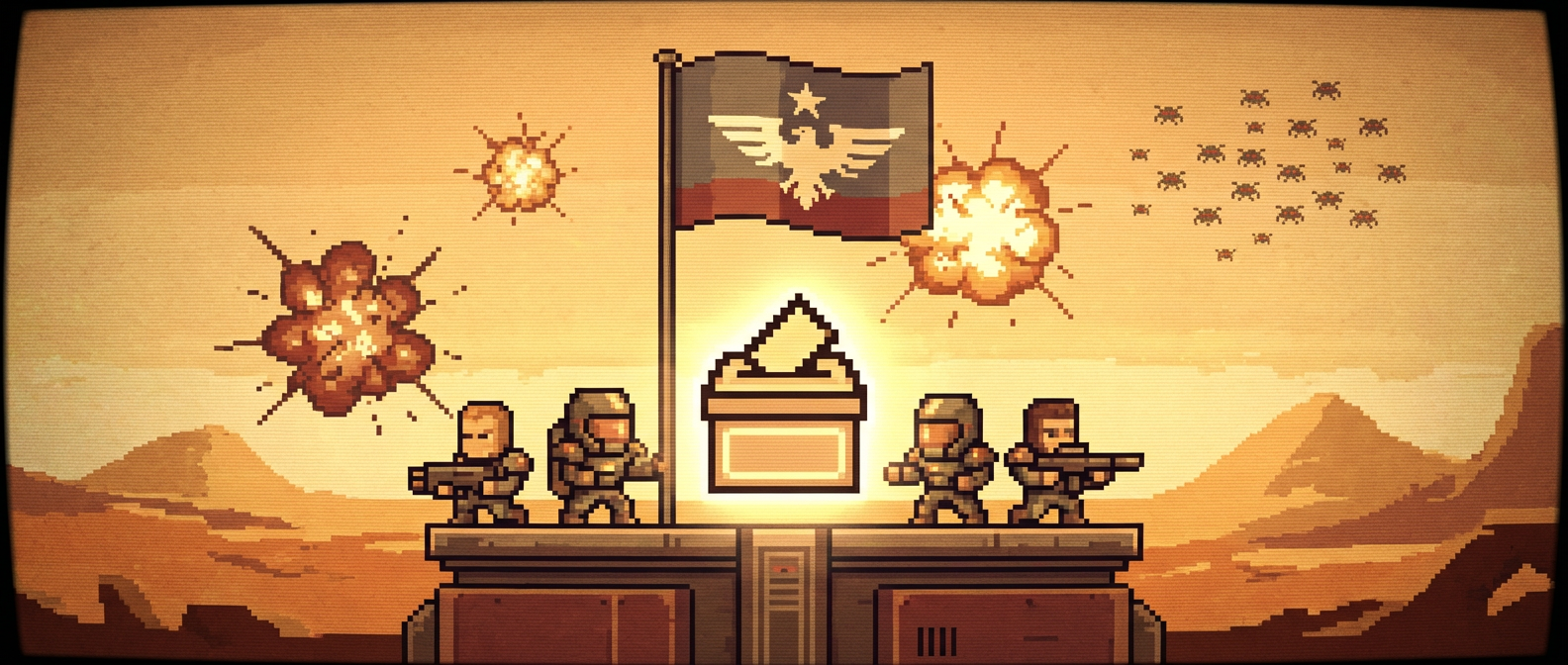
Helldivers 2 Turned 8 Million Gamers Into Democracy Nerds (And It Actually Worked)
When Shooting Bugs Becomes Civic Duty
Look, I’ve seen a lot of community-driven games crash and burn when they try to give players meaningful choices. Usually it’s some half-baked voting system that gets ignored or gamed into oblivion. But Helldivers 2? This game accidentally stumbled into creating the most functional democracy experiment in gaming history, and honestly, it’s kind of beautiful.
Over 8.2 million players participated in democratic planet liberation votes throughout 2025. That’s not just clicking a button and forgetting about it. These decisions directly shaped what content players experienced, which planets got priority for liberation missions, and how the overarching narrative unfolded. When was the last time you saw that many people actively engaged in any democratic process, let alone one involving cartoon space fascism and alien bugs?
The system works because Arrowhead Game Studios did something revolutionary: they made voting feel like it actually mattered. Every Major Order isn’t just flavor text. It’s a binding commitment that changes the game world in real, observable ways. Players aren’t just along for the ride anymore.
The Malevelon Creek Controversy That Broke the Internet
Nothing proved the system’s legitimacy quite like the great Malevelon Creek debate of 2025. Sony’s community-driven narrative system had influenced 23 major story beats throughout the year, but this one hit different. The vote to abandon the planet split the playerbase almost perfectly down the middle: 52% for abandonment, 48% against.
I’ve never seen a gaming community tear itself apart over strategic military decisions quite like this. Discord servers became war zones. Reddit threads turned into dissertations on resource allocation theory. People were writing actual manifestos about why leaving Creek was either brilliant tactical thinking or cowardly abandonment of duty.
The beautiful part? The controversy made players more invested, not less. When your vote actually determines whether entire planets get wiped off the galactic map, suddenly every decision feels weighty. It’s not just background lore anymore. It’s your responsibility as a citizen of Super Earth.
Even researchers at academic institutions took notice. Political science teams at Stanford University found Helldivers 2’s democratic systems compelling enough to warrant serious study, publishing research in early 2026 that analyzed the game’s voting patterns as a potential model for digital democracy. When academics start treating your bug-shooting game as a case study in civic engagement, you know something special is happening.
89% Participation Rates Put Real Elections to Shame
Here’s the stat that should make every political scientist weep: Helldivers 2’s Major Order system achieved 89% player participation rates. For context, that’s higher than voter turnout in most democratic elections worldwide. The Arrowhead Game Studios Community Metrics Dashboard tracks these numbers in real time, and they’re consistently mind-blowing.
Why does it work? Because the consequences are immediate and visible. Vote to prioritize the bug front over the automatons? You’ll see those resources shift within hours. Choose to focus on defensive operations instead of expansion? The galactic map reflects that strategy immediately. There’s no waiting four years to see if your choice mattered.
The game also makes participation feel natural rather than forced. Major Orders blend with normal gameplay loops without disrupting the flow. You’re not stopping your fun to vote on boring policy minutiae. You’re collectively deciding where the next epic battle happens, which enemy faction gets priority attention, and how the war effort evolves.
When Democracy Gets 465,000 People Online Simultaneously
The ultimate test of this democratic experiment came during the Battle for Super Earth’s Capital community event in March 2026. Concurrent player counts peaked at 465,000 people all fighting for the same democratic cause simultaneously. That’s not just impressive from a technical standpoint. It shows how invested players become when they have genuine agency over their shared experience.
What made this event special wasn’t just the numbers. It was watching a community that had spent months learning how to disagree constructively suddenly unite around a common threat. All the Creek controversy, all the faction debates, all the strategic arguments melted away when Super Earth itself was on the line. Democracy had taught them how to argue, but it also taught them when to stop arguing and start fighting together.
The Stanford Digital Democracy Study: Gaming as Democratic Practice specifically highlighted this event as evidence that digital communities can develop sophisticated collective decision-making capabilities when given proper frameworks and meaningful stakes.
Why This Matters Beyond Gaming
Helldivers 2’s democracy experiment succeeds because it solves fundamental problems that plague both gaming communities and real-world democratic institutions. It makes participation rewarding rather than burdensome. It provides immediate feedback on collective decisions. It creates shared investment in outcomes while maintaining individual agency.
Most importantly, it proves that people will engage deeply with democratic processes when those processes have real consequences they can see and experience. The game doesn’t just ask players to vote and hope for the best. It shows them exactly how their collective choices reshape their shared world.
This isn’t just clever game design. It’s a functioning model for digital civic engagement that accidentally emerged from a cooperative shooter about space marines fighting giant bugs. Sometimes the most important innovations come from the most unexpected places.
Have you participated in Helldivers 2’s galactic democracy? What do you think makes their community voting system work when so many others fail? Drop your thoughts in the comments, because honestly, this feels like just the beginning of something much bigger than gaming.
Comments are Disabled